Catamaran vs monohull charter comes down to a genuine trade-off: catamarans offer more deck and cabin space, far less heeling, and shallower draft for accessing more anchorages, while monohulls offer a more traditional sailing feel, better upwind performance, and typically a lower charter price for a comparable size. This guide compares both factor by factor for a Balearic charter week specifically.
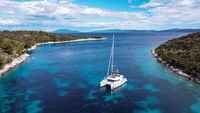
La respuesta corta
Choose a catamaran for more space, a flatter ride, and easier movement around the boat — especially with families, mixed-experience groups, or anyone concerned about seasickness. Choose a monohull for a more traditional sailing feel, better upwind performance, and typically a lower price for an equivalent length.
Both are genuinely capable choices for a Balearic charter — this is a preference decision more than a right-or-wrong one, and both hull types are well represented across the islands’ fleets.
Read on for the detail behind each factor.
Space and comfort aboard
A catamaran’s twin-hull layout creates a wide, open saloon and cockpit that a monohull of the same length simply cannot match — cabins are typically larger too, spread across both hulls rather than stacked along a single centreline. For groups who plan to spend significant time relaxing aboard rather than constantly underway, this space difference is often the single biggest factor in the decision.
The wide, shaded cockpit typical of a catamaran also tends to be the social heart of the boat during the day, while a monohull’s more compact cockpit encourages a slightly different rhythm — more time in the saloon below or on deck cushions rather than around a single large table.
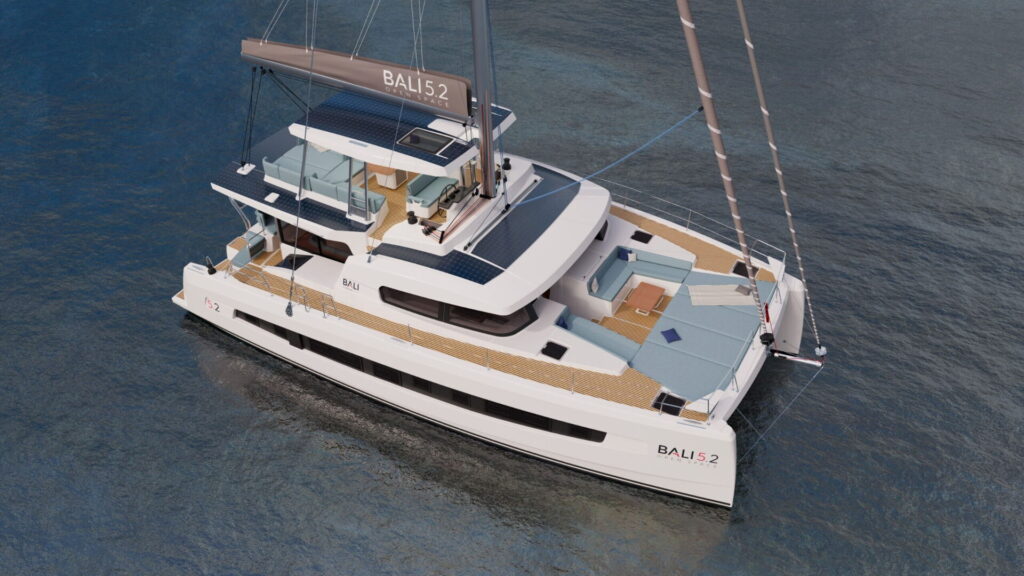
Outdoor living space is where the difference is most visible: a catamaran’s foredeck trampolines and wide flybridge (on larger models) add genuine lounging area that has no real equivalent on a monohull of the same length, where deck space is narrower and more given over to sail-handling gear.
Stability and seasickness
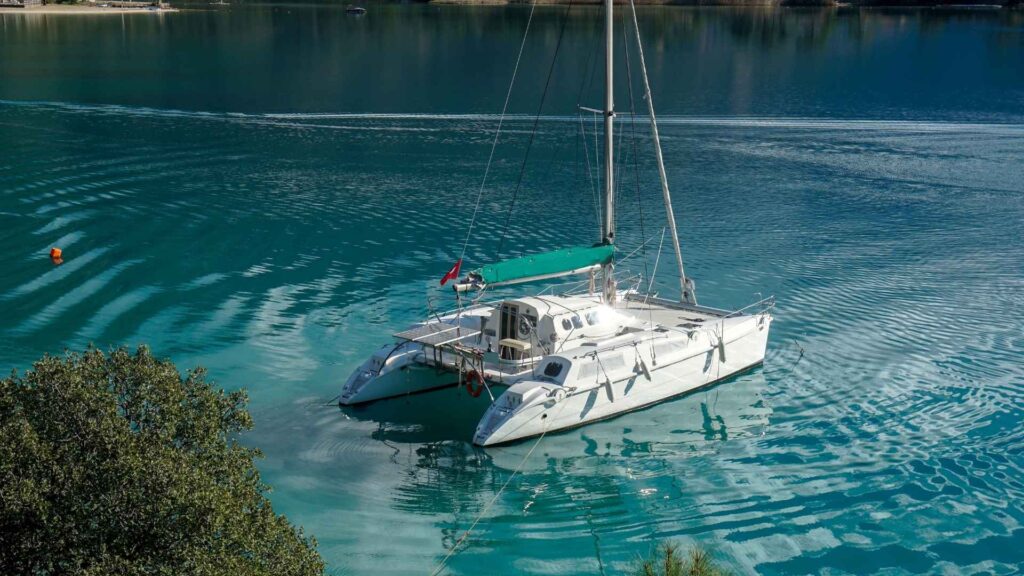
Catamarans heel far less than monohulls under sail, since their stability comes from the width between two hulls rather than a single ballasted keel. This matters directly for seasickness — less heeling and a flatter motion at anchor and underway makes catamarans the more forgiving choice for anyone prone to it, or for a first-time sailing group unused to a boat leaning into the wind.
Monohulls do heel, sometimes considerably in a strong breeze, which experienced sailors often describe as part of the sailing experience itself rather than a drawback — it is a genuine difference in feel, not simply a safety concern.
If seasickness is a known concern for anyone in your group, mention it to the charter company when booking — they can steer you toward a catamaran and toward an itinerary with more anchoring and less open-water passage-making, both of which reduce the chance of a difficult day for a sensitive stomach.
At anchor overnight, a catamaran’s flatter motion in a light chop is also noticeably more comfortable for sleeping than a monohull’s gentle rolling — a difference guests often only notice after the first night aboard either type.
Mention any concerns to your operator ahead of time.
Speed and handling under sail
Downwind and on a reach, a well-sailed catamaran is often noticeably quicker than a comparable monohull, since it carries less wetted surface and no heavy keel dragging through the water. Upwind, the balance shifts — monohulls generally point higher and handle more predictably in rougher conditions, where a catamaran’s wide platform can slap and pound into a head sea in a way a monohull’s single hull does not.
For most Balearic charter routes, which favour coastal hops and sheltered anchorages over long open-water passages, this difference matters less than it would on an ocean crossing — but it is still a real factor for a group that specifically wants the sailing itself to feel a certain way.
Handling technique differs enough between the two that the RYA offers dedicated multihull sailing courses distinct from its standard keelboat syllabus — worth knowing if you are qualified on a monohull and considering a catamaran charter for the first time, since the two do not handle identically even for an experienced sailor.
Sail trim and reefing points also differ enough between the two that a skipper experienced only on one type benefits from a proper handover briefing on the other — not a large barrier, but a real one worth taking seriously rather than assuming a monohull background transfers perfectly.
Draft and anchorage access
A cruising catamaran typically draws around a metre of water, roughly half what a comparable monohull keelboat needs. This opens up shallower anchorages and lets a catamaran sit closer to a beach than a monohull safely can — a genuine advantage in the Balearics, where some of the best anchorages (Ses Illetes in Formentera, for instance) are exactly this kind of shallow, sandy-bottomed water.
This advantage compounds with itinerary planning: a catamaran-friendly route can include anchorages a monohull crew would need to approach more cautiously or skip entirely, particularly around Formentera’s shallower bays.
The trade-off is that a catamaran’s wide beam still needs enough swinging room at anchor, so a very tight, narrow cove may suit a monohull’s slimmer profile better even where depth alone would favour the catamaran — draft is not the only variable that decides which anchorages are practical.
Marina and mooring costs
A catamaran’s wider beam means it occupies more space at a marina berth than a monohull of the same length, and some marinas — including several listed by Puertos de Baleares — charge a beam-based supplement on top of the standard length-based mooring fee. This is worth factoring into your budget alongside the charter rate itself, particularly on a route with several marina nights rather than mostly anchoring out.
Ask for the specific berth fee for your exact boat’s beam when booking, rather than assuming the length-based headline marina rate is the full cost — the difference is usually modest but worth knowing in advance.
Which is more popular in the Balearics?
Catamarans have grown steadily as a share of the Balearic charter fleet over the past decade, driven by family and multi-generational group demand — tourism figures from Illes Balears, the official Balearic tourism board, reflect a broader shift toward comfort-oriented group travel across the islands generally, of which the catamaran charter trend is one visible part. Monohulls remain the larger overall category by fleet numbers, particularly in the mid-size range favoured by couples and small groups, but the gap has narrowed as more operators add catamarans specifically to meet family demand.
Ask your charter company directly about relative demand for their specific fleet and dates — popularity varies by base and season, and a base with a strong catamaran fleet in one location may lean more monohull-heavy at another.
Both remain readily available across the season.
Provisioning and daily life aboard
A catamaran’s extra space translates directly into more usable galley and storage area, which matters over a full week of provisioning for a larger group — fridge and freezer capacity is typically greater too. A monohull’s more compact galley works fine for smaller groups but requires more careful planning around what to buy and when, particularly on longer routes between well-stocked marinas.
Sleeping arrangements also differ meaningfully: a catamaran’s cabins are more likely to be similarly sized across the boat, useful for groups of friends or multiple couples who want equivalent privacy, while a monohull often has one clearly nicer forward or aft cabin and smaller secondary cabins, which can matter for how a group divides up the week’s cost or decides who sleeps where.
Fresh water capacity tends to be greater on catamarans too, relevant for longer showers and dishwashing over a full week without needing a marina refill as often as a smaller monohull might.
Small differences, but ones worth knowing about in advance.
Docking and manoeuvring
Catamarans generally manoeuvre well at low speed thanks to twin engines that allow precise pivoting, which many first-time skippers find easier in a tight marina than a single-engine monohull. Wind can still catch a catamaran’s higher freeboard and wider beam during docking, so it is not without its own learning curve — but the twin-engine control is a genuine advantage most charterers notice within the first day or two aboard.
Monohulls with a single engine require more anticipation of prop-walk and wind effects when docking, a skill that becomes second nature with experience but can feel less forgiving on a first attempt.
Either way, the charter company’s handover briefing should cover the specific boat’s docking characteristics — ask directly if it is not addressed as part of the standard walkthrough.
Practice a few slow-speed manoeuvres in open water before your first marina approach on either type.
Side-by-side comparison
| Factor | Catamarán | Los veleros monocasco |
|---|---|---|
| Space aboard | More, spread across two hulls | Less, single centreline layout |
| Stability / heeling | Minimal heeling | Heels under sail |
| Speed downwind/reaching | Generally faster | Generally slower |
| Upwind performance | Weaker | Stronger, points higher |
| Draft | ~1m, shallow anchorages | ~2m+, more restricted |
| Typical charter price | Higher for equivalent length | Lower for equivalent length |
Which suits your group?
Families, mixed-experience groups, and anyone prioritising comfort and space should lean toward a catamaran. Experienced sailors who want a more traditional feel under sail, better upwind performance, or a lower price for a similar length should lean toward a monohull. Neither is a wrong choice — they suit genuinely different priorities rather than one being a universal upgrade over the other.
Compare real catamaran and monohull listings on our catamaran charter page y sailing yacht page, or see our guide to what is included in a charter price for how costs compare once APA and deposit are factored in.
If you remain genuinely torn, a day charter on each hull type before committing to a full week is a low-cost way to feel the difference for yourself rather than deciding from a table alone.
Whichever you choose, book with a company that maintains both types well, since condition matters more to your week than the hull configuration alone.
Questions about catamarans and monohulls
Clear information before you choose your hull type.
Is a catamaran more expensive to charter than a monohull?
Generally yes, for an equivalent length — catamarans typically command a higher charter rate due to their larger interior space and broader appeal.
Do I need a different qualification to skipper a catamaran?
Multihulls require somewhat different handling technique, and the RYA offers dedicated multihull sailing courses; check with your charter company whether your existing qualification is accepted for their specific catamaran.
Are catamarans safer than monohulls?
Both are safe when handled appropriately for conditions. Catamarans resist heeling better; monohulls tend to handle rough water and strong upwind conditions more predictably.
Which is better for seasickness?
Catamarans, generally — their flatter motion under sail and at anchor is more forgiving for anyone prone to seasickness.
Can a catamaran access anchorages a monohull cannot?
Yes — its shallower draft lets it sit in water a comparable monohull cannot safely enter, opening up more anchorage options.
Tell us how your group plans to use the boat.
We will suggest catamaran or monohull options that fit your priorities and budget.