Yacht charter fuel costs are one of the few costs charterers pay for after use rather than before it — nearly every weekly charter rate on the Balearics excludes fuel, settled at check-in and check-out against what the tank actually shows. How much that adds to your final bill depends heavily on the type of boat and how you sail her: a sailing yacht that spends most of a windy week under canvas can return with the tank barely touched, while a motor yacht cruising for hours a day can burn through hundreds of litres. Marina diesel in the Balearics typically runs €1.60–€1.85 per litre in season. This guide breaks down real consumption ranges by boat type, explains how full-to-full billing actually works, and gives you the numbers to budget yacht charter fuel costs accurately before you choose a boat.
The short answer
For most Balearic charters, yacht charter fuel costs are billed separately from the weekly rate under a full-to-full policy, and how much you pay depends almost entirely on boat type and how much motoring you do. A sailing yacht that sails most of a windy week can add as little as €20–€30 to the final bill; the same yacht motoring through a calm week can add €120–€190. Catamarans typically run higher again because most cruise on two engines. Motor yachts sit in a different bracket entirely — a day’s cruising at speed can burn as much diesel as a sailing yacht uses in a full week.
None of these figures require a large deposit set aside in advance — most charter companies simply add the fuel line to your final invoice or deduct it from your security deposit at check-out, so it rarely needs separate planning beyond knowing the rough range to expect.
How fuel is billed: full-to-full explained
Almost every charter contract in the Balearics excludes fuel from the advertised weekly rate, following the same standard used across the wider Mediterranean charter industry — MYBA, the trade association whose standard contract terms much of the industry references, treats fuel as a charterer expense on top of the base rate, alongside APA on crewed boats (see our what’s included in a yacht charter guide for the full breakdown of what sits inside and outside the headline price).
The mechanism itself is simple: you take the boat with a full tank and return it with a full tank. The base or charter company measures what it takes to refill the tank at handover and bills you for exactly that litreage at the marina’s fuel-dock rate — no estimate, no flat allowance, no argument about how much you actually used. It is the fairest method for both sides, since a charterer who barely motors pays almost nothing, and one who motors constantly pays for what they burned.
In practice, refuelling happens at the charter base’s own fuel dock on the final morning, before or as part of check-out — on a bareboat charter, you or your crew handle it directly; on a skippered or crewed charter, the skipper takes care of it and the litreage is added to your final invoice alongside any other extras. It is worth asking your base for their current per-litre rate before you depart, since Ports de Balears, which oversees marina facilities across the islands, notes that fuel-dock pricing can vary by several cents per litre between bases even on the same island — a detail that matters more on a motor yacht’s fuel bill than a sailing yacht’s.
Sailing yacht fuel consumption
On a sailing yacht, the engine only runs for manoeuvring in and out of marinas, motoring in light or no wind, and topping up batteries — sailing itself burns nothing. In a genuinely good-wind week, a 45ft sailing yacht can return having used as little as 10–15 litres of diesel for the entire charter, essentially just harbour manoeuvres. In a flatter, windless week where the engine carries the boat for several hours most days, that figure can climb to 70–110 litres, since motoring at cruising speed for five hours a day adds up quickly even on an efficient single-engine boat.
Either way, yacht charter fuel costs on a sailing yacht stay modest compared with catamarans or motor yachts — the entire week’s fuel bill rarely exceeds what a motor yacht burns in half a day.

Catamaran fuel consumption
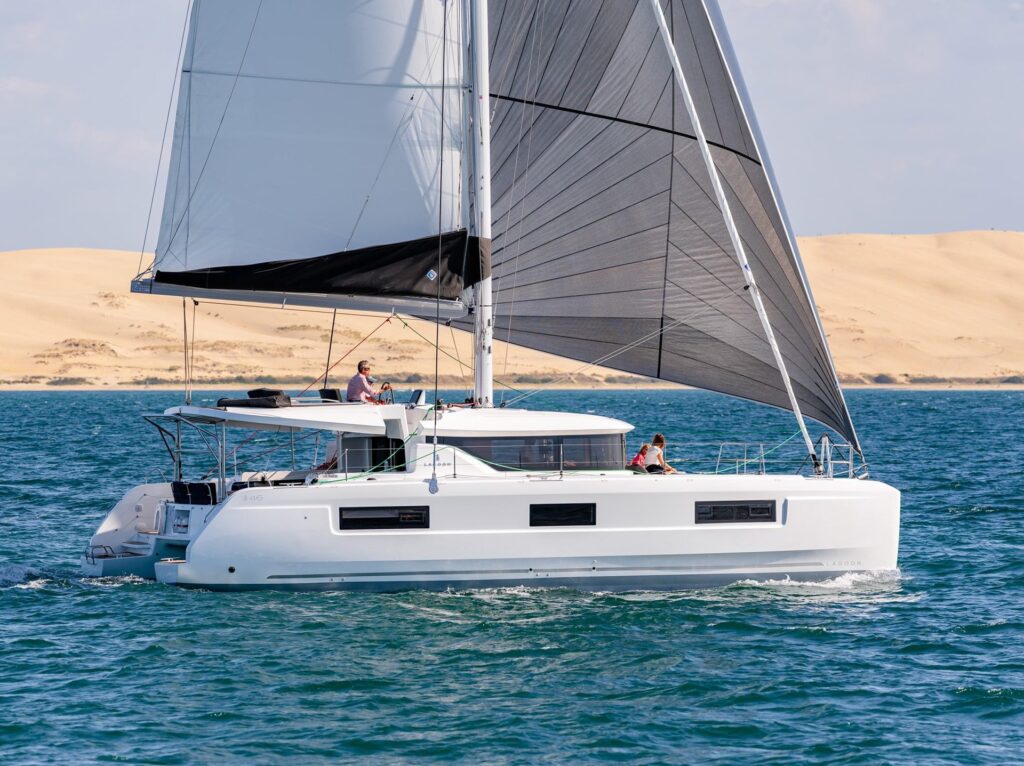
Catamarans complicate the picture because most models, including the Lagoon 46 in our own fleet, cruise on two engines rather than one — doubling fuel burn compared with an equivalent monohull for the same motoring time, even though a catamaran’s hull shape is often more efficient per engine. As a rough rule, budget roughly double the sailing-yacht figures above: 20–30 litres for a good-wind week, and 150–220 litres for a calmer week with more motoring.
Some catamaran skippers run on a single engine at low speed to manage exactly this cost, which is a reasonable technique in calm conditions but reduces manoeuvrability, so it is worth discussing with your skipper (or checking your own comfort level, if bareboat) before relying on it in a tight marina.
Motor yacht fuel consumption
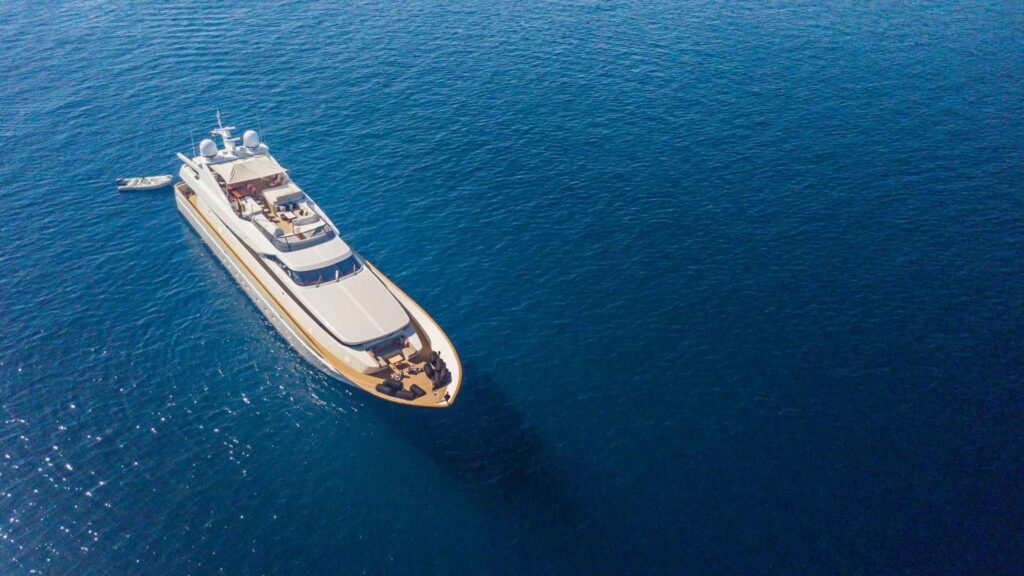
Motor yachts sit in an entirely different fuel bracket because their whole appeal — covering distance quickly, day-tripping between islands, exploring more coastline in a single afternoon — depends on running at real cruising speed rather than drifting under sail. A 40ft motor yacht cruising at around 20 knots can burn 100–150 litres per hour, meaning a single afternoon’s cruising can use more diesel than a sailing yacht consumes in a full week.
This is why motor yacht charter rates in the Balearics are typically structured around day charters or shorter, faster itineraries rather than the leisurely week-long sailing routes covered in our sailing itineraries — the fuel cost of covering the same distance at speed simply doesn’t suit a slow, anchorage-hopping week the way it does a sailing yacht or catamaran.
What affects your weekly bill
Wind conditions do more to move your final fuel number than any other single factor — a windy week built around our best time to sail the Balearics guide can cut a sailing yacht’s fuel bill to almost nothing, while a flat, windless week pushes consumption toward the higher end of the ranges above regardless of boat type.
Cruising speed matters just as much on a motor yacht — dropping from 20 knots to a more economical 12–14 knots can roughly halve hourly consumption, at the cost of a longer passage time. Itinerary distance is the third lever: a route built around nearby, sheltered anchorages (see our anchoring rules guide for where you can and can’t drop anchor) needs far less motoring between stops than one covering long open-water legs. On crewed boats, generator running time for air conditioning and hot water adds a smaller but real amount on top of propulsion fuel, usually itemised separately in the final accounting.
Bareboat charterers can keep a rough running total simply by checking the tank gauge each morning and noting engine hours in the logbook — most yachts show a visible drop after a long motoring leg, so if you are trying to manage the cost yourself, that daily check is more useful than waiting for the final bill to find out. On skippered and crewed boats, the skipper typically already tracks this and can tell you an approximate running total if you ask partway through the week, rather than leaving it as a surprise at check-out.
Typical weekly fuel costs by boat type
The table below pulls the ranges above together at a representative €1.70 per litre — the middle of the Balearic marina fuel-dock range tracked by Statista‘s Spain marine diesel price data — so you can see roughly what yacht charter fuel costs add to a week’s budget by boat type. Treat these as planning figures, not quotes: your operator’s fuel-dock rate on the day of return is the number that actually appears on your invoice.
| Boat type | Typical week's diesel | Estimated cost (at ~€1.70/L) |
|---|---|---|
| Sailing yacht — good wind week | 10–15 litres | €17–€26 |
| Sailing yacht — light/no wind week | 70–110 litres | €119–€187 |
| Catamaran — good wind week | 20–30 litres | €34–€51 |
| Catamaran — light/no wind week | 150–220 litres | €255–€374 |
| Motor yacht — half-day cruising | 300–500 litres | €510–€850 |
Set against a typical weekly charter rate of several thousand euros, even the higher end of these fuel ranges is a small percentage of the total cost — but it is one of the few line items that genuinely depends on your own choices during the week, rather than being fixed at booking. Compare it against the other costs covered in our Mallorca charter cost guide, which breaks down the full weekly budget by boat type and base.

Budgeting for fuel
For most charterers, a realistic fuel budget is €20–€200 for a sailing yacht week, roughly double that for a catamaran, and several hundred euros more for any day spent covering real distance on a motor yacht. Ask your charter company for their exact fuel-dock rate and billing method before you depart — full-to-full is standard, but rates and measurement methods vary slightly between bases.
See our yacht charter prices guide for how fuel sits alongside the other costs outside the headline weekly rate, or go to plan your charter and tell us your boat-type preference so we can set expectations on the full cost, fuel included, before you book.
Questions about yacht charter fuel costs
Clear information before you budget your charter.
Is fuel included in the weekly charter price?
No — almost every Balearic charter excludes fuel from the advertised rate and bills it separately under a full-to-full policy, measured and charged at the marina’s fuel-dock rate when the tank is refilled at check-out.
What is full-to-full fuel billing?
You receive the boat with a full tank and return it with a full tank; the difference is measured at refill and charged at the fuel dock’s per-litre rate — no flat fee, no estimate, no argument about usage.
Does a catamaran use more fuel than a sailing yacht?
Yes, typically around double, since most charter catamarans cruise on two engines rather than one for the same motoring time, even though their hulls are often efficient per engine.
How much fuel does a motor yacht use on a day charter?
A 40ft motor yacht cruising at 20 knots can burn 100–150 litres per hour, so a half-day’s cruising at speed can easily use 300–500 litres, several times a sailing yacht’s weekly total.
Can I reduce my fuel bill on a sailing yacht?
Yes — sail rather than motor whenever wind allows, choose a windier charter week using our best-time-to-sail guide, and keep your itinerary to nearby anchorages rather than long open-water legs.
Tell us your boat type and we'll set fuel expectations.
We include realistic fuel guidance in every quote, not just the headline weekly rate.